
Looking for the perfect sim racing setup Kochi? Discover the best wheels, pedals, cockpits, and software to kickstart your virtual racing journey.
The Ultimate Sim Racing Setup for Beginners: Gear, Software & Tips
Motorsport has always been an exclusive, expensive pursuit, but the digital age has shattered that barrier. Today, anyone with a passion for speed can experience the thrill of pushing a GT3 car to its limits on the Nürburgring from the comfort of their home. Building a sim racing setup for beginners might seem overwhelming at first. You are instantly bombarded with terms like direct drive, load cells, aluminum extrusion, and telemetry.
Fortunately, getting started is easier than you think. You do not need to spend thousands of dollars on day one to be competitive. The key is understanding where to invest your budget and how to choose hardware that grows with your skills. In this comprehensive guide, we will break down exactly how to build the ultimate sim racing setup for beginners, cover the best simulation software, and offer tips to make you faster on the track.
What is Sim Racing?
Sim racing replicates real-world physics using advanced tire models and laser-scanned tracks. Consequently, a setup requires dedicated hardware for precision. Real F1 drivers also use it for practice.
Consequently, a sim racing setup Kochi requires more than just a standard video game controller. While you can technically play with a gamepad, the precision required to trail brake into a hairpin or catch a slide at 150 mph demands dedicated hardware. Real-world drivers, including Formula 1 champions like Max Verstappen and Lando Norris, use sim racing to practice tracks and refine their reflexes between real races.
If you want to transition from casual gaming into serious digital motorsport, upgrading your hardware is the first mandatory step.
The Core Hardware: Building Your First Sim Racing Setup Kochi
When assembling a sim racing setup for beginners, you need three primary components: a wheelbase, a steering wheel, and a pedal set. You will also need a stable way to mount them. Let’s explore each category.
1. The Wheelbase and Force Feedback
The wheelbase is the motor that drives your steering wheel. It provides force feedback (FFB), which communicates the physics of the car to your hands. Through the wheel, you feel the bumps in the road, the loss of traction, and the weight of the car shifting.
There are three main types of wheelbases:
- Gear-Driven: These are the entry-level standard, popularized by wheels like the Logitech G29 and G923. Inside the base, a small motor connects to the steering shaft via gears. They are highly affordable and highly durable. However, they can feel somewhat clunky or “notchy” as you turn the wheel.
- Belt-Driven: Moving up the tier list, belt-driven bases (like the Thrustmaster T300) use a rubber belt system. Therefore, they offer smoother, stronger, and quieter force feedback than gear-driven models.
- Direct Drive (DD): This is the gold standard of sim racing. The steering wheel connects directly to a large industrial servo motor. There are no belts or gears to dilute the force feedback.
In the past, direct drive wheels cost thousands of dollars. Today, companies like Moza Racing, Fanatec, and Simagic offer beginner-friendly direct drive bases that deliver incredible detail for under $500. If your budget allows, starting with an entry-level direct drive wheelbase is highly recommended because you will not need to upgrade it for years in your sim racing setup Kochi.
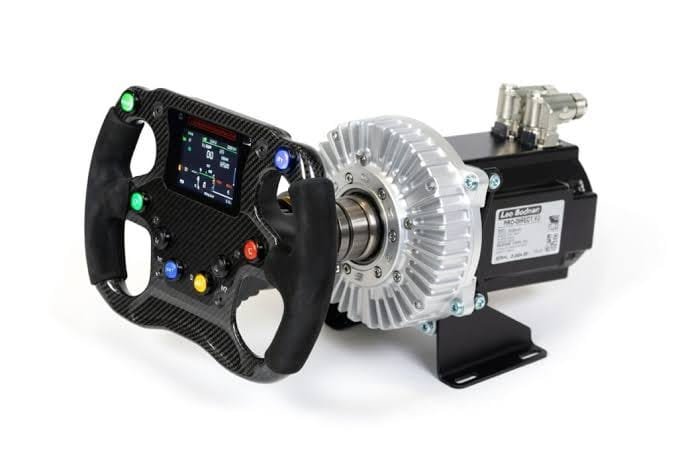
2. The Steering Wheel Rim
Once you have a wheelbase, you need a wheel rim to attach to it. Your choice depends heavily on the type of cars you want to drive.
- Round/D-Shape Wheels: These are the most versatile. If you plan to drive rally cars, drift cars, or classic manual transmission vehicles, you need a round wheel. It allows you to let the wheel slide through your hands during massive steering corrections.
- Formula/GT Wheels: These wheels are rectangular or butterfly-shaped. They feature heavily contoured grips, multiple rotary encoders, and bright shift lights. Because modern GT and Formula cars rarely require you to turn the wheel more than 180 degrees in either direction, a full circle is unnecessary.
Many beginners start with a simple round wheel to keep their options open. As you specialize in a specific discipline, you can invest in a dedicated Formula wheel.
3. Pedals: The Secret to Speed
Many beginners assume that a better steering wheel will make them faster. In reality, your pedals are the most critical component for shaving seconds off your lap times. Braking is the hardest skill to master in sim racing, and the type of brake pedal you use directly impacts your consistency.
- Potentiometer Pedals: Entry-level setups measure the distance the pedal travels. If you push the pedal halfway down, you get 50% braking power. Because human muscle memory is poor at memorizing exact spatial distances, it is incredibly difficult to brake consistently with potentiometers.
- Hall Effect Pedals: These use magnets to measure the pedal’s travel distance. They are more durable than potentiometers because there is no physical contact to wear out, but they still rely on distance measurement.
- Load Cell Pedals: This is where everything changes. A load cell measures pressure rather than distance. Just like in a real car, the pedal is stiff, and you brake by pressing harder, not further. Human muscle memory is excellent at remembering applied pressure. Consequently, upgrading to load cell brakes is the single best investment you can make for your sim racing setup.
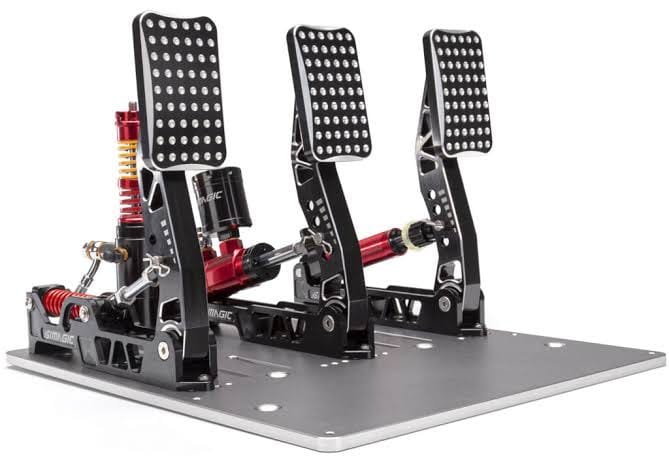
4. Cockpits and Wheel Stands
You cannot mount a powerful direct drive wheel and stiff load cell pedals to a flimsy wooden desk. The force feedback will rattle your monitors, and pushing the brake will simply push your office chair backward across the room.
- Desk Clamps: Acceptable only for low-power, entry-level gear-driven wheels.
- Wheel Stands: A foldable metal frame that holds your wheel and pedals. You use your own chair, but you can lock the chair’s wheels into a tray. These are great if you have limited space and need to pack your gear away in a closet.
- Tubular Steel Cockpits: These are full rigs with a dedicated racing seat attached. They look great and provide excellent immersion. Examples include the Playseat Trophy or the Next Level Racing F-GT.
- Aluminum Profile Rigs: Often called “80/20 rigs,” these are built from industrial aluminum extrusions. They are infinitely adjustable and completely rigid. An aluminum profile rig will handle the strongest direct drive wheels without flexing. While they take time to assemble, they are the final, permanent solution for any serious sim racer.
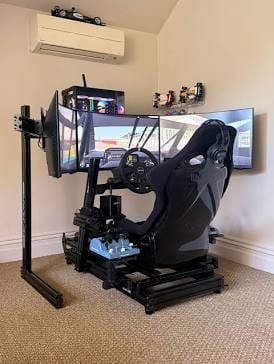
Display and Vision: Seeing the Track
Field of View (FOV) is critical. If your FOV is wrong, corners look distorted. Therefore, proper display setup is essential. Single monitors are common, but ultrawides and triples offer wider peripheral views. Virtual Reality (VR) provides true depth perception, though it is demanding on hardware.
- Single Monitor: A standard 16:9 monitor is the most common starting point. To make it work for sim racing, mount the monitor as close to your steering wheel as physically possible. This maximizes your horizontal field of view, allowing you to see the apex of the corner. A 27-inch or 32-inch 1440p monitor with a high refresh rate (144Hz or higher) is ideal.
- Ultrawide Monitors: Stepping up to a 21:9 or 32:9 ultrawide monitor provides a massive advantage. A 49-inch super ultrawide monitor wraps around your peripheral vision. As a result, you can easily look through the side windows of the virtual car to spot the apex on tight hairpins. Furthermore, ultrawides only require one display cable and are easier to configure than multiple screens.
- Triple Monitors: Triple monitors are the gold standard for competitive esports racers. By angling two side monitors at 45 to 60 degrees, you create a seamless 180-degree field of view. You can see cars pulling up alongside you in your peripheral vision, making close-quarters racing much safer. However, triple monitor setups require a powerful PC, three identical displays, and meticulous software configuration to align the bezels perfectly.
- Virtual Reality (VR): For ultimate immersion, nothing beats a VR headset like the Meta Quest 3, HP Reverb G2, or Pimax. VR provides true depth perception, allowing you to gauge braking distances intuitively. You can physically turn your head to look at your mirrors or stare down the apex. However, VR is incredibly demanding on your computer’s graphics card, and long endurance races can cause eye strain or motion sickness for some users.
Software: The Best Sim Racing Setup Games Kochi
A high-end rig is useless without the right software. The sim racing market features several major titles, each catering to a different style of player.
Assetto Corsa (AC)
Released in 2014, Assetto Corsa remains one of the most popular simulators in the world. Its longevity is entirely due to its massive modding community. Through third-party apps like Content Manager, players have transformed AC into a visually stunning, modern title. You can drive almost any car on any track ever created, from Tokyo highways to obscure Japanese mountain passes. It is an essential purchase for any beginner, especially since it frequently goes on sale for under five dollars.
Assetto Corsa Competizione (ACC)
Unlike its predecessor, ACC is a highly focused simulator dedicated entirely to GT3 and GT4 racing. It is the official game of the GT World Challenge. ACC features industry-leading tire physics, dynamic weather, and incredible audio design. If you want to master the intricacies of modern downforce cars and participate in endurance racing, ACC is currently the benchmark.
iRacing
If you crave competitive multiplayer, iRacing is the undisputed king. Operating on a subscription model, iRacing enforces a strict safety rating system. If you crash into other drivers, your safety rating drops, and you are banned from higher-tier series. As a result, the racing is exceptionally clean and highly competitive. Furthermore, iRacing actively punishes bad behavior, forcing drivers to learn race craft. Every professional real-world driver uses iRacing, and it hosts official esports championships for NASCAR, IMSA, and Porsche.
Automobilista 2 (AMS2)
Powered by the Madness Engine, Automobilista 2 excels in visual presentation and dynamic weather. It features a fascinating roster of historic Formula 1 cars, Brazilian stock cars, and classic tracks. The Force Feedback is superb right out of the box, and the AI is highly competent for offline racing.
Dirt Rally 2.0 and EA Sports WRC
If track racing sounds boring, you can take your rig to the gravel. Rally simulators require a completely different driving style, focusing on weight transfer, Scandinavian flicks, and handbrake turns. These titles provide a terrifying, adrenaline-fueled experience where a single mistake sends you rolling down a mountain.
Essential Driving Techniques for Beginners
Buying the best sim racing setup for beginners will not instantly make you a professional driver. Sim racing requires dedicated practice and an understanding of vehicle dynamics.
Here are three fundamental techniques every beginner must learn:
Sim racing requires practice and technique rather than just hardware. Key methods include:
- Trail Braking: Holding brake pressure while turning to keep weight on front tires.
- Looking Ahead: Focusing on the apex and exit rather than the hood.
- Smooth Inputs: Treating controls like dials instead of switches.
Building Your Community: Sim Racing Setup Kochi
A sim racing setup Kochi is not just about the driving; it is about the community. Joining a league is the best way to improve your skills. Racing against the same group of people every week builds trust and allows you to practice close-quarters racing safely. Platforms like Discord and Reddit (specifically r/simracing) are excellent places to find beginner-friendly leagues.
You can also utilize telemetry software like Garage61 or VRS to compare your lap times and pedal inputs against faster drivers. Analyzing your data will quickly reveal where you are braking too early or carrying too little speed through a corner.
Conclusion: Start Your Engines
Assembling a sim racing setup for beginners is a highly rewarding journey. The technology has never been more accessible, and the software has never been more realistic. By prioritizing a solid cockpit and load cell pedals, you lay a foundation that will serve you for years. Start with entry-level cars like the Mazda MX-5, focus on driving smoothly, and avoid the temptation to overdrive the car.
Sim racing requires patience, practice, and a willingness to learn from your mistakes. Take your time, enjoy the process of shaving tenths of a second off your personal bests, and welcome to the grid. The green flag is waving and we are waiting to setup your own sim racing setup Kochi.
CONTACT US: https://thedelta.store/services/
